I was sitting at my desk. Twenty-five degrees, spring finally landed in Barcelona, the fan humming in the background, birds on the terrace, my dog barking because a neighbor was sneaking past the door. One of my research bots was running its daily sweep for new AI stories, and I was waiting on the output to drop into the queue. It dropped. I started scrolling.
What I read gave me hot flashes. Not the I-knew-this-was-coming kind. The I-knew-this-was-coming-but-not-this-fast kind. Somehow a CNBC report from May 2023 had slipped past me at the time — three years old, sitting in the bot's output as if it were brand new. Chegg. Down 49% in a single trading session.
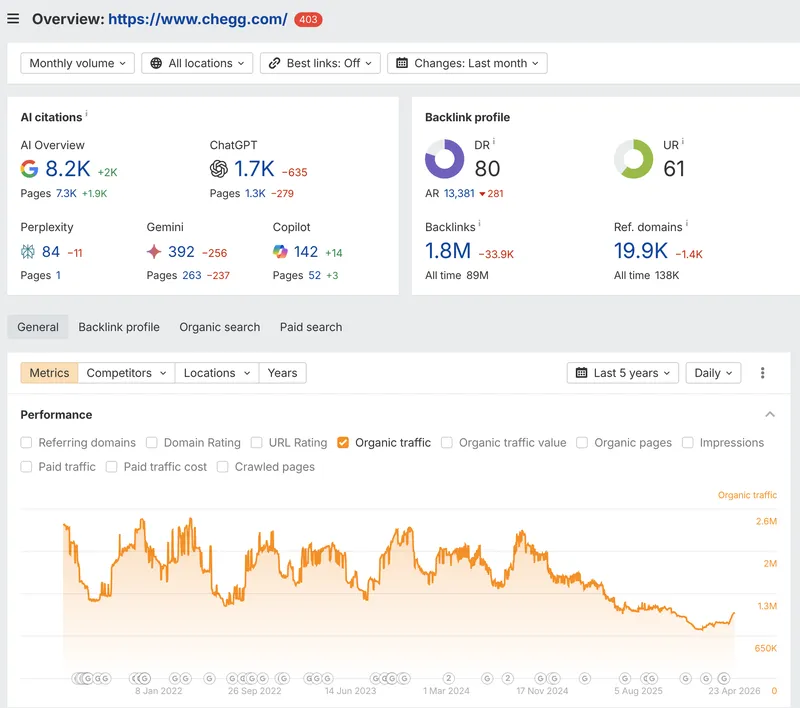
The first publicly-traded company to admit, on the record, that ChatGPT was killing its business. And my first thought wasn't about 2023. It was about the next quarter. With Opus and Mythos and whatever launches next, shipping straight into the workflows that the 2023 version of ChatGPT could only hint at, what is the economic fallout going to look like this time around?
That's the frame the rest of this piece sits inside. The new discipline everyone is calling AI strategic visibility is the work of ensuring your brand is cited — frequently, accurately, and favorably — whenever someone asks ChatGPT, Gemini, Perplexity, or Google's AI Overview for a recommendation in your category. It's a different game from classical SEO because the ranking signals are different. Entity recognition in knowledge graphs. E-E-A-T — Experience, Expertise, Authoritativeness, Trustworthiness. Schema markup that AI extractors can actually parse. Information gain, meaning data or insight that the other cited sources in your category don't have. Continuous monitoring of how AI models talk about your brand and whether the framing is accurate. If you're not measuring those, you're hoping, not competing. And hoping has a very specific cost now.
Scroll down to the hard numbers in the bot's output. A company with 79 million solved homework problems in its database. A $767M subscription engine. A market cap of $14 billion in February 2021 — reduced in two and a half years to $191 million. Ninety-nine percent of its value gone. And in October 2025 the final note: forty-five percent of the workforce laid off, 388 people walking out of offices. This isn't a slow correction. This is a company disappearing in time-lapse. The trigger isn't a better product from a competitor. The trigger is that Chegg became invisible to AI models at the exact moment AI models became the default answer engine for a generation of students.
What Is AI Strategic Visibility (And Why It Has Two Faces)
Ask ten people what the term means and you'll get two different answers. Both are correct. That's the problem.
The first meaning is the one the AI Overview above already sketches and the one most founders who call me are circling back to: visibility of your brand inside the answers AI models produce. Entity authority, E-E-A-T signals, structured data, information gain, mention monitoring. All of it feeding one question, do you show up in the three-to-five sources an AI model cites when someone asks about your category?
The second meaning is the one enterprise IT is starting to care about, and it sits right next to the first one in the Ahrefs keyword cluster. CIOs are increasingly talking about AI governance strategic visibility — what's happening to the AI tools your employees are already using without IT knowing? Shadow AI. Who's feeding which customer data into which prompt? Which decisions are being made on the back of AI outputs nobody validated? That's visibility into AI.
Both visibilities are strategic. Both are missing in most companies. And two years of client work have made it clear to me that they're connected. If you don't know what AI models are saying about you, and you don't know what your own teams are doing with AI, you're already inside the Chegg pattern before you notice the pattern has a shape. That's what I want to walk through in the rest of this piece.
AI Search Optimization in 2026: The New Rules Under the AI Overview
Before every new engagement, I throw three queries into ChatGPT, Claude, Gemini, and Perplexity that my client probably hasn't typed into her own tracking software. "Best SaaS for X". "Alternative to Y". "Who does Z in Berlin". Over the last sixty days I've run this test for twelve clients. Three of them show up consistently in the three-to-five cited sources. Nine of them don't. None of the nine had tested it. None of the nine had a framework to measure it.
That's AI search optimization in 2026, stripped to its essentials. You get cited, or you don't get cited. The classical ranking factors I've been teaching since 2012 now explain roughly 45% of AI visibility. The other 55% is the list the AI Overview itself surfaces: entity clarity, E-E-A-T signals, structured data, information gain, and the ongoing monitoring that tells you whether any of the above is actually landing. The Yahoo Finance case study from February 2026 describes a company that grew its AI Overview visibility 667% in six months by optimising exactly these signals in a structured way. The counter-example is Chegg, which played the domain-authority game for a decade and paid for it with 99% of its market cap.
The distinction between ranking and citation isn't academic. It determines whether your content shows up as a cited source or whether it shows up as training data with your name scrubbed off the output. And it's measurable, once you know how.
The Chegg Pattern: What Losing AI Visibility Actually Costs
Back to Chegg, because the case beats any slide deck I've ever built.
In March 2023 management flags, internally, a sudden spike in student interest in ChatGPT. On May 2, 2023 the CEO says it publicly, in an earnings call, and the stock loses almost half its value in a single session. A billion in market cap, gone. That's the first publicly-documented instance of a listed company naming generative AI as the cause of an existential business cut. The thing that separates this from every prior tech disruption is the pace. Between "first signal" and "framed as existential threat" the gap was about eight weeks. Eight weeks.
What comes next is the Chegg pattern chain, which is now textbook. Google's AI Overview amplifies what ChatGPT started. Students get homework answers directly in the SERP, no click-through. Chegg doesn't just lose subscribers, it also loses the organic referrals that fed the subscription engine in the first place. In May 2025 the company lays off 22% of staff. In October 2025, another 45%. The ticker chart looks like a cliff jump in slow motion — February 2021 at $14 billion, November 2024 at $191 million.
What won't let go of me about this case isn't the size of the numbers. It's the clarity of the causal chain. Chegg had everything the old playbook told them to want — the content library, the domain authority, the SEO infrastructure, the brand recall in their core market. And that was the problem. The old playbook had fitted them to a landscape that had stopped existing. The invisibility that hit them wasn't a gap in the funnel. It was the funnel. The whole thing, compressed into an answer box and displayed at the top of Google.
When someone asks me today what the Chegg story actually teaches, my answer is this. Visibility inside AI models is no longer the top of the funnel. It is the funnel, rebuilt on infrastructure you don't control. And when you get locked out of that infrastructure, the lockout isn't gradual. It's a single trading day.
This Isn't One Company: The Industry-Wide Shift
After my first pass of the Chegg numbers, I read them again that evening, back at my apartment with the laptop on the couch. Then I opened the ZipTie study in a tab that had been waiting for three days. The chair shifted under me as I scrolled.
Seventy-three percent of B2B websites lost significant traffic between 2024 and 2025. Average decline, 34% year-over-year. That's not one company. That's three quarters of all B2B websites at the same time, across one year, losing a third of their organic traffic. The Superlines analysis adds an even harder detail: ChatGPT recommends only 1.2% of all local business locations when a user asks for a recommendation. Ninety-eight-point-eight percent of all local businesses are simply invisible to the fastest-growing recommendation engine in consumer behaviour.
And as if that weren't enough. Organic CTR on queries where an AI Overview appears has dropped 61%. AI models cite three to five sources per response. Seventy-three percent of the marketing teams I've spoken to over the last six months don't have a single tool in their stack that measures whether their brand is being cited at all. Between December 2025 and January 2026, ChatGPT listicle citations decreased by 30%, meaning the surface area brands have to compete for is actively shrinking, not growing.
When I show these numbers to a founder for the first time, there's usually a beat of silence, then the line: "but that can't apply to us". I pull up the live test queries in her own market. In eleven out of twelve cases the answer comes back the same. Yes, it applies to you. And you watch the statistic turn into a very specific quarterly problem, right across her face.
AI Governance Strategic Visibility: When AI Starts Attacking Your Brand
Then the third piece. A Fortune article from March 12, 2026. A study that analysed hundreds of millions of AI prompts, with one finding that nearly knocks me off the chair. Google's AI Overviews surface negative brand content for the same query 44% more often than ChatGPT's answer to the same question. Forty-four percent. Not 44% more often than nothing — 44% more often than a competitor model processing the same query. Marketing teams spent a decade comfortable with the idea that negative content sits on page ten of Google's organic results. That content is now sitting at the top of the AI Overview box. Sometimes it's the first thing a prospective customer reads about the brand.
This is the other side of strategic visibility, the side the CheckPoint CIO article frames as governance. AI governance strategic visibility isn't just about controlling what your employees do with AI tools. It's also about seeing what AI tools are doing to you. What does ChatGPT say about your brand today when someone asks? What surfaces in the Google AI Overview when a prospect types your product name plus "review"? Which sources do the models pull when they assemble answers, and where do those framings come from?
The uncomfortable truth is that most marketing teams and most CIOs have never measured this together and never connected the dots. Marketing measures brand mentions in media. IT measures internal AI usage. Nobody measures, in real time, what the public-facing AI says about the company, and nobody measures, in real time, what the internal AI is doing with company data. Both gaps turn into risks you only see when they're sitting on the front page of an analysis.
What I Tell Clients Now About AI Strategic Visibility
When I sit across from a founder today and ask her where she stands on AI strategic visibility, I ask three questions, and I write her answers on a napkin.
First. When did you last take the top ten buying queries in your category, run them through ChatGPT, Claude, Gemini, Perplexity, and Google's AI Overview, and document whether your name appears in the answers and how it's framed? If the answer is "never" or "six months ago", you don't have a brand-visibility measurement. You have a hope.
Second. Do you know which AI tools your own employees are currently using productively — including the ones they installed without IT approval — and which data they're feeding into which prompts? If the answer is a shrug, you don't have governance visibility. You have an audit problem with an unknown timestamp.
Third. If ChatGPT tomorrow recommends a competitor and leaves you out of an answer in your category, how long before you notice? If the answer is more than seven days, you're not measuring, you're hoping. And hoping isn't a strategy anymore, not once the market rhythm has compressed to eight weeks between first signal and existential crisis.
Out of those three questions falls a framework I'm now running across six Avandex AI mandates and three RocketGrowth clients. Weekly AI prompt audits that re-run the same twenty buying queries every seven days and track citation share across the four major models. Monthly shadow-AI inventories at device level that document which AI tools are running inside the company and what data they're touching. Quarterly brand-reputation scans that explicitly hunt for the negative framings the Fortune study describes. And all three streams landing on a single shared surface where marketing and IT see the same picture, not siloed reports behind separate logins.
This isn't a new marketing discipline. It's an early-warning system.
What I'm Still Watching
I'm sitting here knowing several things I don't yet know. I don't know whether Chegg pulls off any kind of resurrection, or whether in three years we'll look back at the case the way we look back at Kodak. I don't know which industry is next to ride the Chegg curve, but my three best 2026 candidates would be consumer tax software, certain segments of the coaching industry, and travel comparison portals — categories where the AI answer is close to compressing the entire comparison funnel into itself. If you work in one of those markets, my read is you should start measuring your citation rate this month, not in a year.
And I don't know what the shared definition of AI strategic visibility will look like once it settles, maybe eighteen months out. The Ahrefs cluster already shows "ai governance strategic visibility" and "ai contextual governance strategic visibility" each pulling over a thousand global monthly searches — terms that had no measurable demand twelve months ago. The discipline is consolidating in real time. Whoever sets the frame sets the standard for the next five years. That's one of the rare windows where a mid-sized operator has more leverage on a category than the big consulting houses, because you can measure and act faster than they can update their decks.
What I'm sure of is that the Chegg story isn't the exception, it's the template. When I look back at this from five years out, May 2, 2023 will stand as the marker — the day the first large company said, on the record, that AI had dissolved its business model. And 2026 will register as the year strategic visibility against AI models stopped being a marketing discipline and started being a question of corporate survival.
The open question is how many companies notice in time, and how many find out from an article like this one, while the train is already pulling out of the station in their own category.